The Learner’s Apprentice: AI and the Amplification of Human Creativity
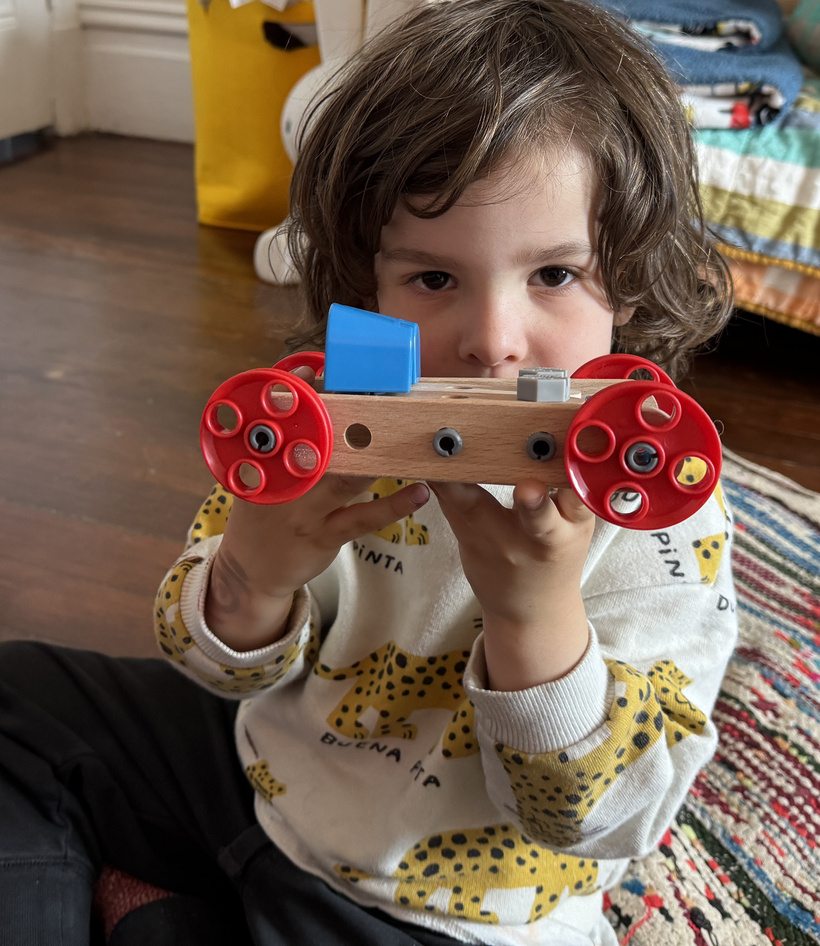
My grandson's Montessori school has a poster that says "help me do it myself," and that certainly was his attitude even before preschool. I like to provide construction tools, from lego to erector sets, like his latest Brio construction set. When I try to show him how, invariably he reacts "I can do it myself." Even though he often can't. So I wait while he messes around and once in a while I demonstrate how to do what he is trying to do. Lately, I've had some success in showing him how illustrated instructions, which he calls "the map," can help him do it himself.
All this is to say that I immediately ordered The Learner's Apprentice: AI and the Amplification of Human Creativity when I saw it had been edited by Sylvia Libow Martinez, who I interviewed a few years ago. A key phrase from that interview stuck with me: "Making is a stance toward learning that puts the learner at the center of the education process." Her book, co-authored with Gary Stager, Invent to Learn: Making, Tinkering, and Engineering in the Classroom is still highly recommended for parents and teachers. A key paragraph from the latter book:
Making and building projects that personally interest students and an iterative design process don’t mean that teachers’ guidance becomes less necessary. A good corollary to “education is an igniting, not a pouring,” is “without banks, a stream would be a lake.” Teachers are there more to show students how to learn than to instruct them, step by step, what to do – they can get that from YouTube or Instructables. By combining learner autonomy, powerful materials like Arduino or Raspberry Pi, and guidance, teachers can give students permission to explore and help them gain fluency in the art of learning in the real world.
Now educators at every level are challenged by what to do about chatbots like chatGPT. The upheaval over the use of chatbots to write essays and otherwise cheat the educational process as it is now conducted in most schools has dominated the discourse. I agree that there are real concerns about the lack of compensation to the creators whose materials were used to train LLMS, and about the energy and water use required to train; nevertheless, chatbots are not going away and are only going to increase in power and the population of users. Like social media, the question is one of literacy: how to teach young people to use these tools responsibly, and in ways that enhance rather than shortcut their learning. I can't think of a better place to start than this book.
The key is to teach young people how to use the tool to create rather than cheat. The Learner's Apprentice promises to enable learners to:
Make software – without learning to code: Learn to make playable interactive games, scientific simulations, augmented reality games, and mobile apps. Make AI-enhanced software apps and train your own machine learning tasks.
Create history, science, and literature adventures: Build historically accurate interactive adventures, debate with notable figures, or create immersive science fiction stories in any language.
Design mathematically rich representations: Create charts, graphs, and apps that explore mathematics from proofs to data science.
Enhance creativity and storytelling: Write and illustrate stories across different styles, time periods, and subjects, and connect creative writing to various disciplines.
Arguably, the power to create your own games can be made more appealing than cheating, and the ability to create narratives and adventures around curriculum, to train chatbots on Aristotle's texts and use them to dialog with the philosopher, may, with the help of knowledgeable educators, induce students to use LLMs to augment, rather than fake their intellectual capabilities