Art-making and the life force (2) - deeper dive
(Part One)
Six years ago, I wrote about the way a paintbrush brought life back to my mother after catastrophic surgery that left her unable to move or speak. It has been a decade and a half since my mother passed, and I've had another remarkable experience, so I decided to take a deeper dive.
A friend I've known for well over half a century have been sinking into Alzheimer's dementia. I won't get into the heartbreak of watching a dear friend dissolve. This is about what I've been learning from my attempt to do something to help.
I brought the friend to Ruth's Table, a place in San Francisco's Mission District that was founded by the artist Ruth Asawa. They have workshops for people with cognitive impairment, so I brought my friend, not knowing what to expect. I have failed to interest this friend in any art or craft over the decades of our friendship, but when they handed out inexpensive watercolor sets (seven bucks on Amazon!) and put large tree leaves on the table, my friend painted a pretty good likeness of a fall-colored oak leaf. They were pleased with it (I am using this pronoun to help anonymize my friend) so I bought them their own set and we started making watercolor paintings together. I have decades of experience with oil and acrylic paints, but I've shied away from watercolor because I can't control it as well. I started watercoloring in order to encourage my friend so I decided to stop caring about being able to control the paint or to faithfully render an idea or physical object. That turned out to be fun.
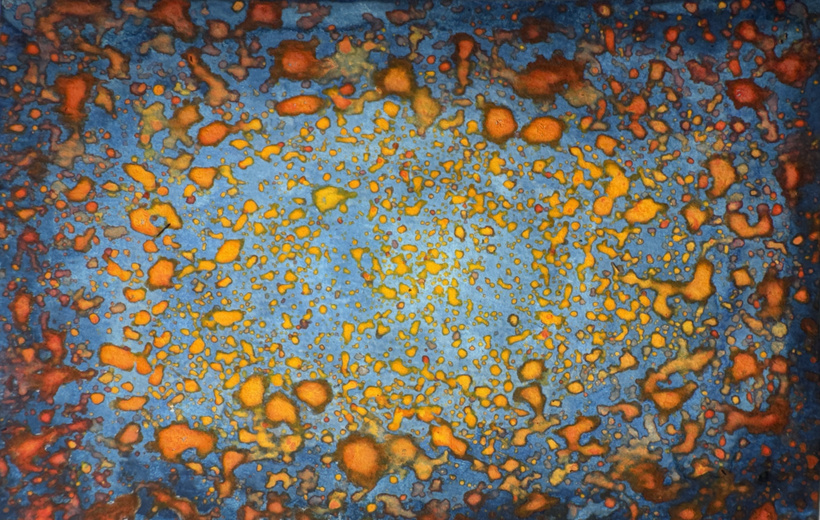
As the disease progressed, my friend started exhibiting muscular twitches and jerks that stirred their entire body. I was surprised to see that the muscular movements must not be involuntary because they stopped entirely while my friend was painting. Their memory didn't improve, but their voicing their desire to go "home" to the place they lived as a child and which no longer exists ceased for the duration of their painting session. I had grown accustomed to hearing their need to return to a place that isn't there -- maybe a dozen times over a couple hours. They were not only calm, but focused, concentrated, joyful while wielding the brush. I put on some music. We started painting together regularly.
The disease has continued to progress in the year and a half since we started painting, but the quality of their painting seemed to improve over time. In no other area of their life has their ability improved. In every area of their life that required cognition, their abilities have steadily degraded. Sometimes, they become anxious and distressed. I've learned that putting a paintbrush in their hands instantly soothes. Every single time. The paintbrush had become a magic wand.
I thought and wrote about this kind of magic years ago and until my recent experiences, I didn't inquire about whether others were having similar experiences. So I've recently started looking into research on the measurable effects of art-making on mood and cognition. It turns out that there is a lot of it. What I witnessed with my mother and with my cognitively impaired friend aligns with a growing literature: making art can reduce stress physiology, support mood, and even complement rehab goals like fine‑motor control. At the same time, researchers caution that study quality varies, so we should celebrate these gains without overclaiming.
Levels of the hormone cortisol is one physiological measure of stress -- high levels of cortisol correlate with high levels of stress. So one way of measuring the effects of art-making on stress is to measure cortisol before and after making art. I wasn't surprised to learn the results of one small study:
This quasi-experimental study investigated the impact of visual art making on the cortisol levels of 39 healthy adults. Participants provided saliva samples to assess cortisol levels before and after 45 minutes of art making. Participants also provided written responses about the experience at the end of the session. Results indicate that art making resulted in statistically significant lowering of cortisol levels. Participants' written responses indicated that they found the art-making session to be relaxing, enjoyable, helpful for learning about new aspects of self, freeing from constraints, an evolving process of initial struggle to later resolution, and about flow/losing themselves in the work. They also reflected that the session evoked a desire to make art in the future. There were weak associations between changes in cortisol level and age, time of day, and participant responses related to learning about one's self and references to an evolving process in art making. There were no significant differences in outcomes based on prior experiences with art making, media choice, or gender.
Keep in mind that this and other studies in stress physiology are not claiming significant effects on the disease. But as anyone who deals with dementia knows, there is the disease, and there is the way the patients and those around them react to the disease. Reducing stress and improving mood probably doesn't alter the course of Alzheimer's Disease, but it certainly improves the quality of life for patients and everyone around them.
It turns out that there is more than this study -- quite a bit more. Before I get to what I've been finding, I've decided to introspect in real time, typing into this post how I personally feel about the art-making process. As I've written elsewhere, I've been drawing and painting and sculpting for as long as I can remember. I never had a scintilla of ambition to try to make a living as an artist. I started thinking of being a writer as a teen, reading a lot of science fiction and boy-lit such as Jack London, Alexander Dumas, Robert Louis Stevenson. On The Road is what sealed the deal for me at age 16. So painting has always been a private conversation with myself and the elan vital, regularly opening the fonts of creativity that all humans are born with until criticism and self-doubt shut them down. Over the 70 +years that have passed since I first put crayon to paper, I've come to recognize that sometimes I try to depict something visible or imagined and sometimes I paint in order for the painting process to tell me what the painting is.
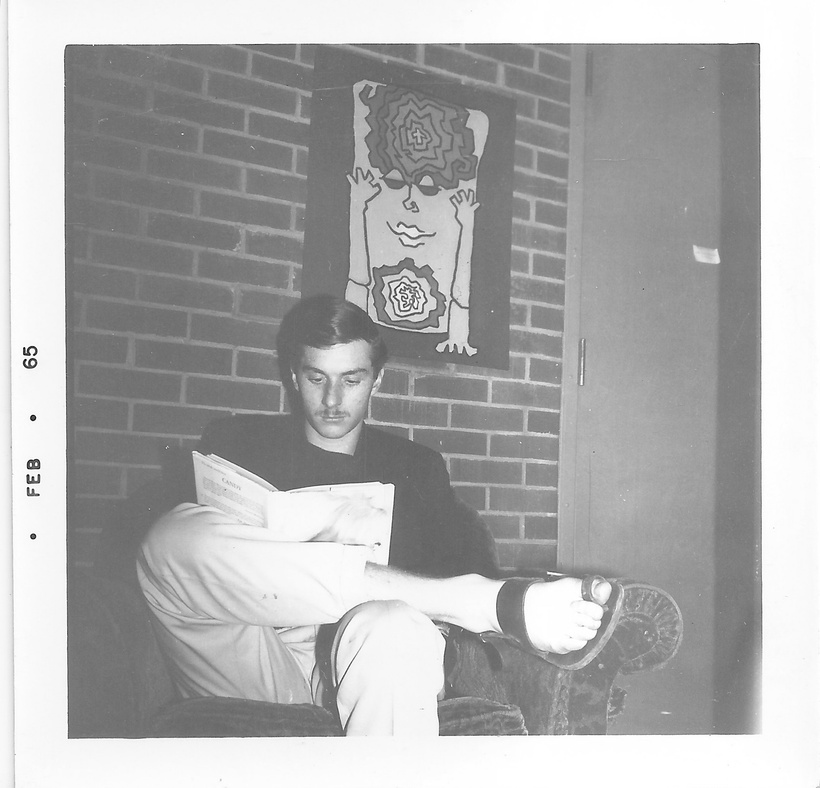
The "helpful for learning about self" from the cortisol study rang my bell. I don't know whether to call it soul, higher self, creative unconscious, daemon, but that process of letting the painting tell me what it is was, I understand in retrospect, a lifelong evocation of my deeper, nonconscious but wiser self. I've written elsewhere about the relationship of this kind of painting and the kind of forecasting I did at Institute for the Future. I delved into the Jungian side of the creative unconscious in my 1968 Reed Thesis.
Around a decade ago, I was walking down a street in Manhattan when I came upon the Rubin Museum for the first time. Inside was an exhibition of Jung's Red Book.
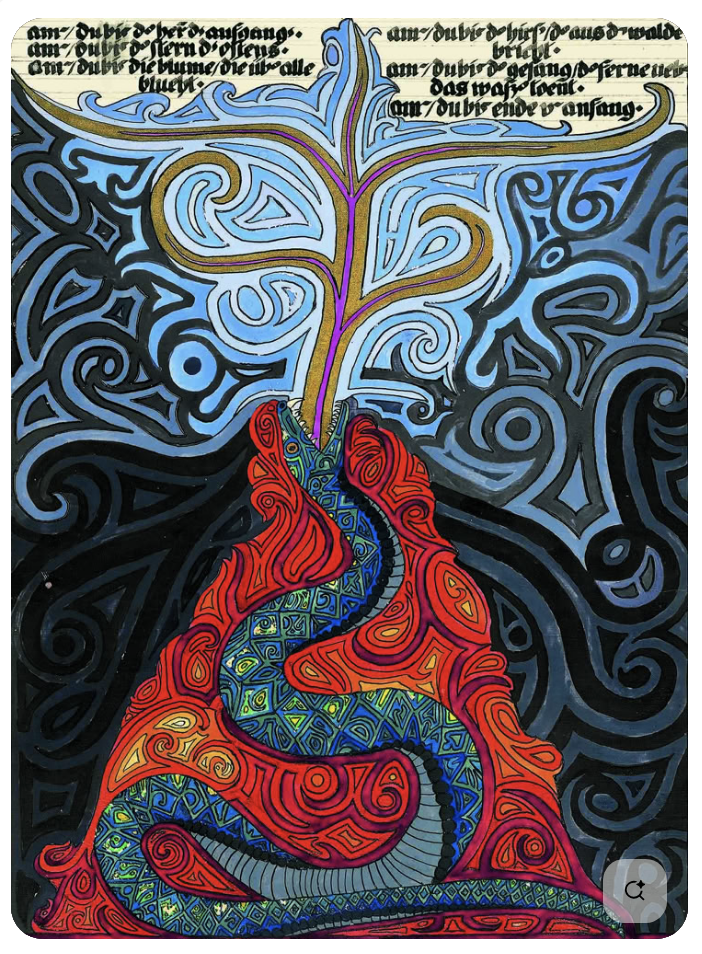
(Image is of a Pinterest board of all the images in The Red Book)
Again, I felt rung like a bell. Either I had absorbed Jung's ideas from here and there and they surfaced in my work, or I was tapping into something similar to what Jung tapped into when he created -- painted and wrote -- his Red Book. The Jung Institute has offered a course on where the Red Book came from. So in my experience, art-making has been not just about cultivating intuition and experiencing joy, but a process of broadening and deepening my participation in the creative force behind life and the cosmos. And clearly I'm not the first to experience this. I wanted to point to this deeper dimension of art-making before I turn to the research on art-making and relieving some of the angst of dementia -- of even transforming angst into joy. To be clear, I'm talking about taking up a brush or a lump of clay as a means of relieving stress and evoking joy, not formal Art Therapy, a regulated mental health profession.
In my next post on this subject, I will get into a brief, provocative, and not at all comprehensive literature review of art-making and mental health studies.