The past futures of Howard Rheingold (2)
Originally published for paying Patreon members on 2018-03-19. Republished here after a 90-day patron-first period.
Artobiography, continued
Since my teens I’ve continually and ritually explored parts of my mind that can’t be sensed through words. There’s a part of art that involves seeing in new ways and manifesting that way of seeing in an artifact that has some effect on the minds and senses of the viewer. And there’s a part of art that is about allowing new forms to come into being through the artist; this part requires the artist to look rather than see, and to help give form to whatever is bubbling up. My visual art often follows where the manifesting form takes me, rather than rendering an image I already hold in my head. I’ve practiced the art of turning on my internal intuition faucet and then manifesting foresights into communicable media when they come to me through the flow.
I’m still reaching beyond my grasp. The art I’ve been wanting to make lately is requiring me to learn woodwork and electronics, 3D painting and VR sculpture. Paint and light have always counterpointed; recent technologies make it possible to mix the olden and modern media in ways that weren’t affordable by most artists until now. In recent years, I’ve used Arduino microcontrollers, Raspberry-pi media players, video screens, and other technologies in combination with painted,laser-cut, spider-woven and hand-crafted wooden and stone objects.
As soon as a new digital medium allows it, I’m eager to play with my old paintings in new ways: As soon as Apple’s first big clunky plastic digital camera was available in the 1990s I turned paintings into web pages and, more recently, fabric swatches. A 2015 illuminated music box projects LED light through a silk fabric printed with the design of a PhotoShopped image of a painting I made in 1973.
<figure>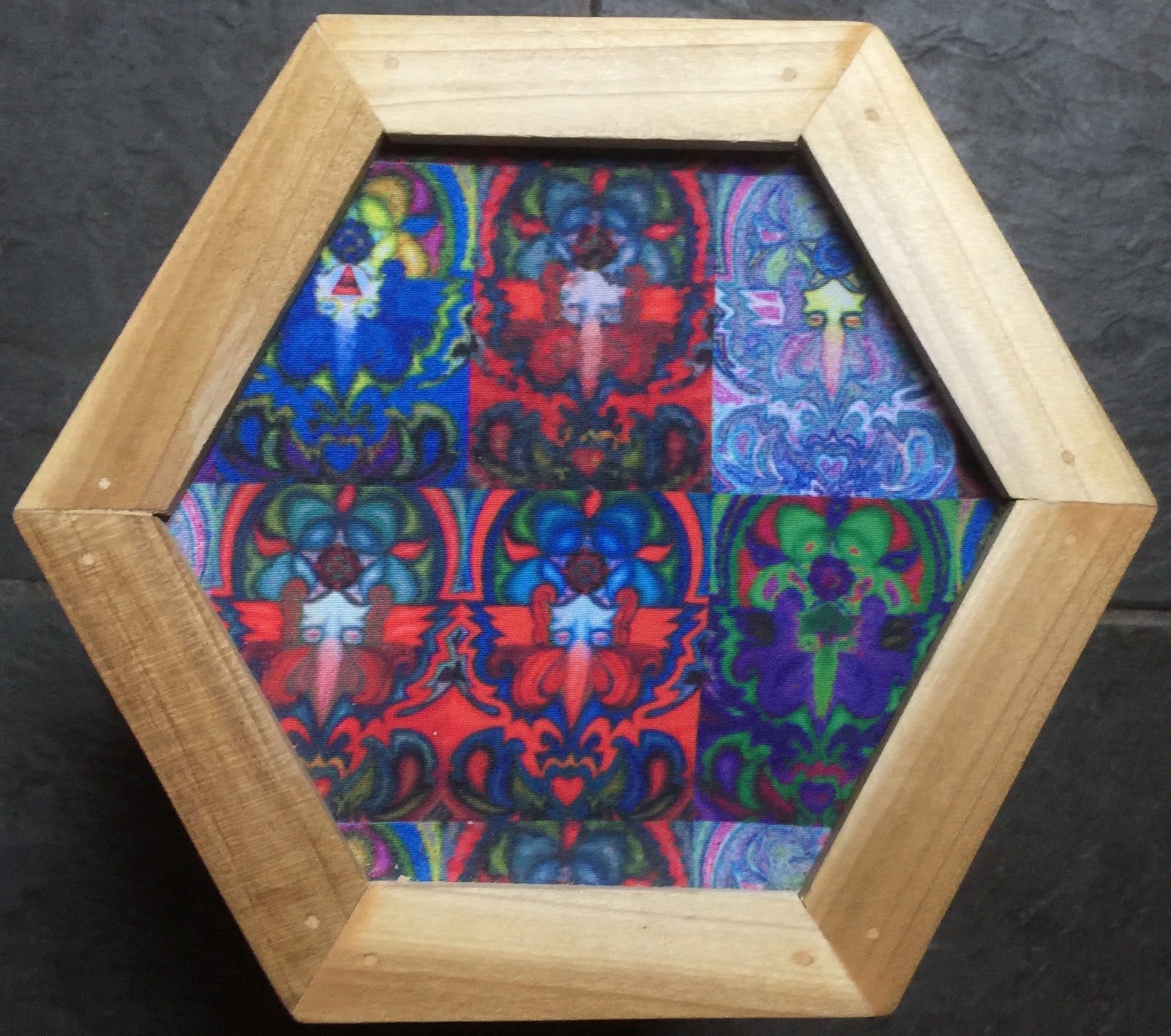
My book about Virtual Reality was originally published in 1990, and I ignored the field for the next twenty five years….until I experienced Tiltbrush VR painting in Institute for the Future’s Emerging Media Lab in 2016. When a new media-art dimension becomes available, I leap into the rabbit hole.
Although this is the first time I’ve written about my creative process and its relation to my forecasting, I’ve been paying attention to that process for a long time. In the early 1980s, I worked with Willis Harman: who created the future studies department at Stanford Research Institute (now SRI International). An electrical engineering professor at Stanford, he became involved in early research on LSD and creativity. He wrote an important book on forecasting: “An Incomplete Guide to the Future,” and he and I co-authored Higher Creativity, subtitled: “Liberating the Unconscious for Breakthrough Insight.” I encountered Harman through my research into a 1977 Playboy article on “Future Highs.”