Toward A Social Media Classroom
Will somebody put together a free and open source social media classroom? Together with developer Sam Rose, I instigated the creation of a SMC in 2008, but it's grown old and obsolete. Time for someone to step up and create a new one. Here is a brief description of why I felt educators needed such a thing, how I used it, and what a more up-to-date version should entail.
In 2005, together with MacArthur Fellow Xiao Qiang I started teaching students at Berkeley about "participatory media and collective action." Subsequently, I also ended up teaching a course there on "Virtual Community/Social Media" and courses at Stanford on "Digital Journalism," "Social Media Issues," and "Social Media Literacies." I'm saying all this to indicate that my use of social media in the college courses I taught stemmed directly from the subject matter rather than a desire to introduce new technology: If we were to study social media, it only made sense to use it. I had some ideas about how forums, blogs, wikis, in particular could extend and augment the face to face classroom meetings, but my understanding of social media pedagogy grew from my experience. As I learned to frame it for my students, my inquiries into how they were experiencing our use of social media was essential to my part of the "co-learning" we were attempting together.
In 2005, "learning management systems" at Cal and Stanford included crude forums, but to me, the LMS was about managing the business of teaching, from taking roll to keeping track of grades. So I used a forum from one vendor, a blog from another, and a wiki from a third. Students immediately complained that they had to log in to three separate platforms with three different user interfaces. So when HASTAC and MacArthur Foundation announced a contest for innovators in digital media and learning, I submitted my scheme for a browser based learning environment that would include a forum, blogs for the class as a whole and for each student, and a wiki. When my project was chosen as one of the winners in the first competition, I used the award money to hire a developer and create the SMC to my specs. I wrote about this in more detail for MacArthur's digital media and learning site.
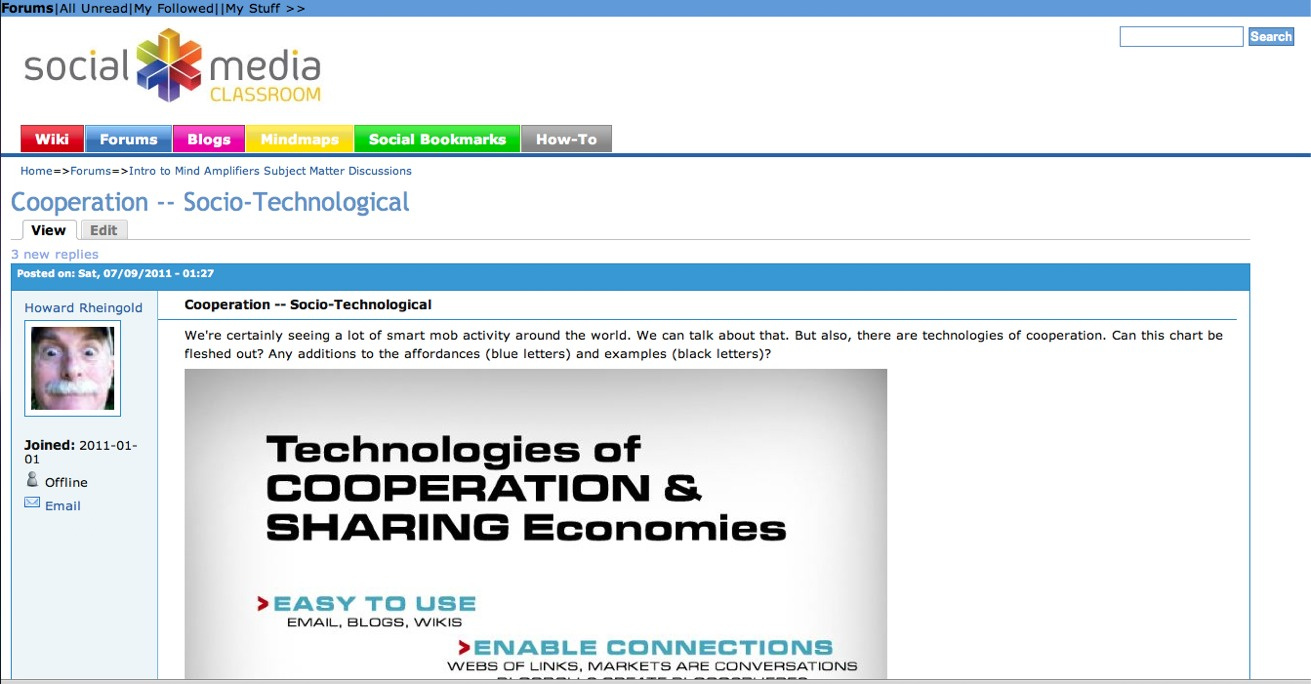
In regard to how we used each medium, I framed it for my co-learners in terms of "voice." The forum is the voice of the class as a cooperating entity; each blog is the public voice of each individual learner; wikis and Google Docs are workspaces for melding individual voices into negotiated, discussed, and agreed collaborative documents. I've written a post about why and how to use forums. In addition to that post, I would add that forums enable us to continue our face to face classroom conversations during the time between class meetings; so often, a rich and lively conversation engages the classroom...and then the bell rings. I asked my learners to form co-teaching teams who help me engage and present; one of the duties of the co-teaching teams is to select topics for weekly forum discussion from the candidate topics that all students provide after they do their readings for the week and participate in the classroom discussion of those readings. I found that two factors that helped catalyze an engaged co-learning community were whether we were able to arrange a dinner or lunch together early in the term and whether the learners became engaged in the forum. I remember the first time a forum conversation caught fire: it was early in my teaching, when Napster was popular. A learner started a topic thread on "If you use Napster, are you stealing?" and within a week there were hundreds of posts.
While forum topics were chosen by co-teachers from suggestions made by other learners, and were meant to be group discussions, learners were free to choose topics for blog posts as long as they were relevant to the syllabus. I emphasized the importance in the age of social media of developing a public voice; each learner had the option to make their blog posts visible to the public or confined to our class. One of the reasons teaching this way is more work for the instructor is that I always endeavored to post a response to the first blog posts of every learner. Learners were encouraged to comment on each other's posts, and quite often the comment threads were as lively or more lively than those in the forum.
The wiki was where learners engaged in collaborative document creation. One of the duties of co-teaching teams was to identify words and phrases from the texts, lectures, discussions, that would be useful to know. During the week after a class session, it was the task of all co-learners, including the instructor, to fill in the definitions, add links, alphabetize, correct punctuation. This also offered an answer to the perennial question: "What is going to be on the final?" I was able to answer: "It's up to you." The final consisted of an essay of any length in any medium, covering the topics we engaged during the term, using as many of the words in the lexicon in proper context as possible.
We also used social bookmarking and mindmaps, which are handy additions to the SMC, but in my experience, the forum, blogs, and wiki (or Google Doc) are the essential building blocks. An advanced SMC would enable each learner to tag and concatenate their forum posts, blog posts, blog comments, wiki entries, into a composite document at the end of the term -- a learning journal/digital portfolio.
Right now, it is possible for educators and students to secure an inexpensive "domain of one's own" and install Wordpress blogs, Discourse forums, and Mediawiki. The next step would be to create a package that would automatically install these, accessible through separate tabs on the course website. Even better would be a less arcane wiki. Someone should do it.