Guardian video (2)
Originally published for paying Patreon members on 2019-09-17. Republished here after a 90-day patron-first period.
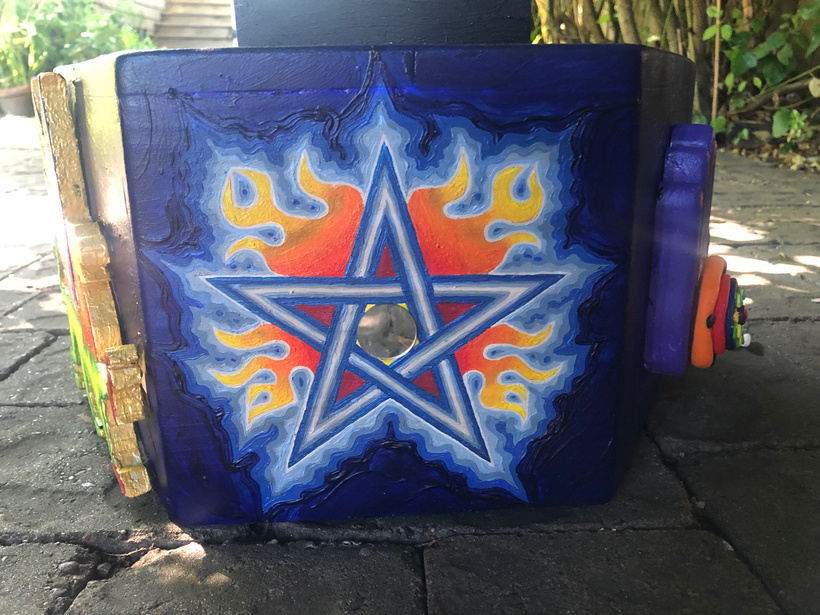
(Read through this whole post and reference all the links, and you will have completed a mini-course on the nature of the internal and external universe in the language beyond words -- symbols)
The pentagram faces forward, toward the entry, and is the first thing that a visitor sees after opening the gate. (There is a mirror in the center of the pentagram. You have to stoop down to really see it, but I figure it registers subconsciously on visitors -- reflecting back to them whatever they are bringing through my gate). This five-pointed star, enclosing a pentagon (which can enclose infinitely nested pentagons and pentagrams),
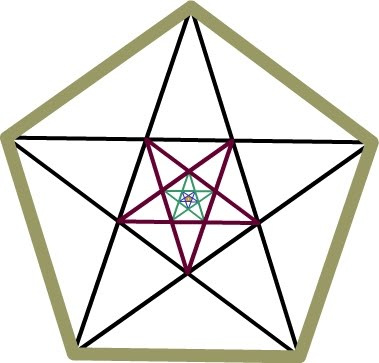
(Source: https://math.stackexchange.com/questions/229008/area-of-nested-pentagrams-ii)
is perhaps the most well-known instance where an ancient cultural symbol with layers of esoteric meaning erupts into popular culture. In the case of the pentagram, the popular culture version of the star represents "magic" and a pentagram on the floor is the foundation of both esoteric and popular notions of magical operation. These are both accurate, but there is more.
My favorite examination of the meanings of the pentagram is in A Beginner's Guide to Constructing the Universe, which I highly recommend to anyone intrigued by this post. The chapter on the pentagram-pentagon is titled "Regeneration":
This fascinating characteristic of living forms curiously corresponds with the geometric property of the pentagram to replicate forever smaller and larger versions of itself. The star replicates and inverts itself in its own central pentagon, which in turn has its central pentagon, in an endlessly diminishing series of inverting stars.
Flip the central pentagram outward and it transform at each of the stars five points into a whole pentagram. These become nuclei for smaller stars to replicate within, in its center and around its points, multiplying endlessly. The Pentad holds the principles of the geometry of regeneration. It is nature's way of producing endless variety using a single self-reproducing scheme.
...
We hold the proportions of the solar system in our hands, face, and whole body. One can fold an outline of the human body differently and create the proportions of a starfish and seashell, a rose, and the Milky Way galaxy. Perhaps the entire universe is a great, living, intelligent being we just don't recognize, in the same way that one cell in your body doesn't suspect the existence of the person reading this or even have the ability to comprend your possibility.
By turning from the world outside ourselves to the subtle world within, we move from the symbolic to the sacred. In symbolic geometry the essential principle of the Pentad is life and "regeneration," expressed by the property of self-similarity. Inwardly, this characteristic indicates the possibility of spiritual regeneration, rebirth from the human to the divine as sought by every one of history's religions.
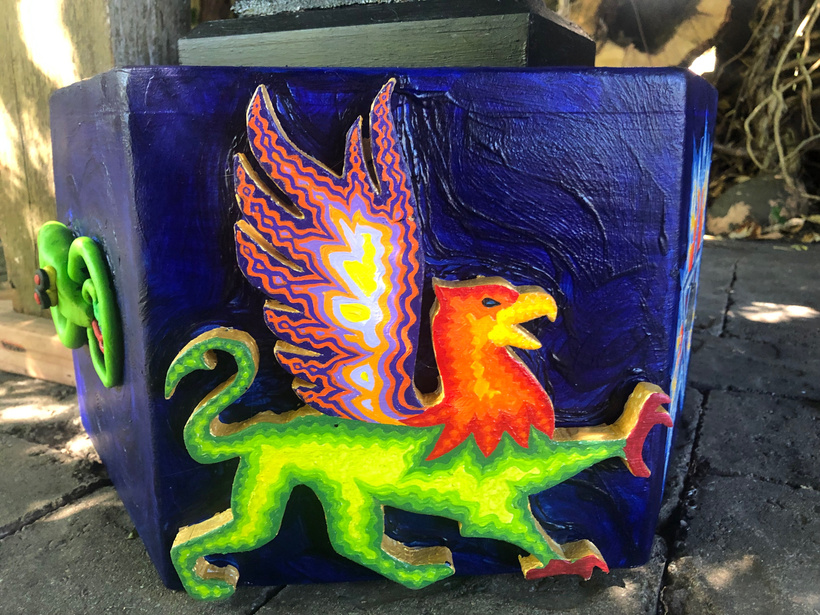
a legendary creature with the body, tail, and back legs of a lion; the head and wings of an eagle; and sometimes an eagle's talons as its front feet. Because the lion was traditionally considered the king of the beasts, and the eagle the king of the birds, by the Middle Ages the griffin was thought to be an especially powerful and majestic creature. Since classical antiquity, griffins were known for guarding treasures and priceless possessions. In Greek and Roman texts, griffins and Arimaspians were associated with gold deposits of Central Asia. Indeed, as Pliny the Elder wrote, "griffins were said to lay eggs in burrows on the ground and these nests contained gold nuggets."In medieval heraldry, the griffin became a Christian symbol of divine power and a guardian of the divine.
Also the mascot of Reed College, my alma mater)
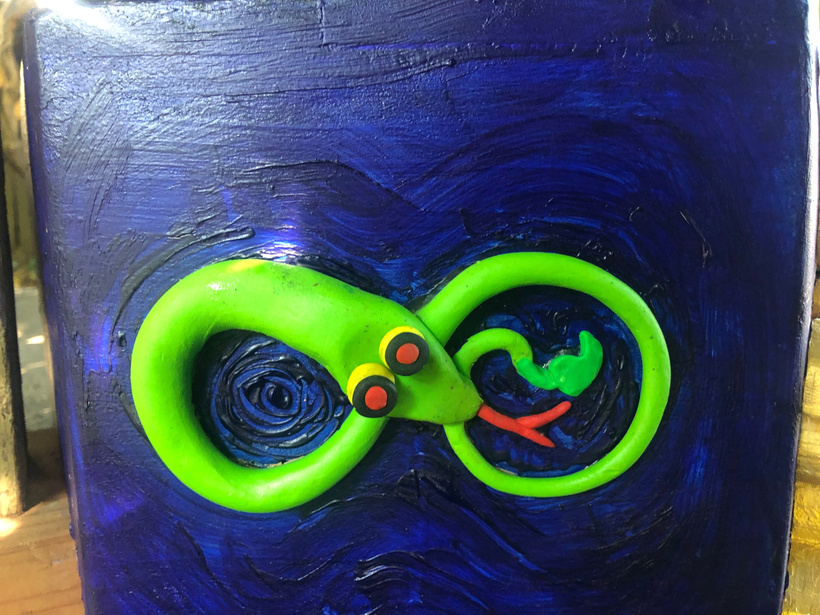
Have you ever wondered why the Buddha is protected by the hood of giant snake in many sculptures? The snake is known as a naga, and it protects the Buddha on behalf of the earth. Snakes live in the ground and therefore know the secrets hidden below the earth (or below the conscious mind). And don't forget that the serpent in Eden tempted Eve with...knowledge. When the snake is in the form of a lemniscate or eternity symbol, it can symbolise the metaphysically hair-raising notion of eternal return: everything that happens, happens an infinite number of times. That gives me the willies when I think that every thought and action of mine are going to happen to some version of myself, and already has happened to some version of myself. To me, an even more vertiginous idea is the possible marriage of the multiverse (there is more than one universe) and the many-worlds interpretation of quantum physics (every possible alternative to every action happens in one of an infinite number of universes, which means that anything that can happen has happened and will happen an infinite number of times.) The metaphysical pretzel this thinking turns me into leads me to suspect that either I or language or both lack the capacity to even imagine what might be happening. Which brings me back to the foundational text of my personal religious belief, the statement attributed to J.B.H Haldane: "The universe is not only queerer than we suppose; it is queerer than we can suppose."
Wikipedia entry for Ouroboros:
Kekulé's proposal for the structure of benzene (1872) The German organic chemistAugust Kekulé described the eureka moment when he realized the structure of benzene, after he saw a vision of Ouroboros:
I was sitting, writing at my text-book; but the work did not progress; my thoughts were elsewhere. I turned my chair to the fire and dozed. Again the atoms were gamboling before my eyes. This time the smaller groups kept modestly in the background. My mental eye, rendered more acute by the repeated visions of the kind, could now distinguish larger structures of manifold conformation: long rows, sometimes more closely fitted together; all twining and twisting in snake-like motion. But look! What was that? One of the snakes had seized hold of its own tail, and the form whirled mockingly before my eyes. As if by a flash of lightning I awoke; and this time also I spent the rest of the night in working out the consequences of the hypothesis.
In Gnosticism, a serpent biting its tail symbolized eternity and the soul of the world. Swiss psychologist Carl Jung saw the ouroboros as an archetype and the basic mandala of alchemy. Jung also defined the relationship of the ouroboros to alchemy:
The alchemists, who in their own way knew more about the nature of the individuation process than we moderns do, expressed this paradox through the symbol of the Ouroboros, the snake that eats its own tail. The Ouroboros has been said to have a meaning of infinity or wholeness. In the age-old image of the Ouroboros lies the thought of devouring oneself and turning oneself into a circulatory process, for it was clear to the more astute alchemists that the prima materia of the art was man himself. The Ouroboros is a dramatic symbol for the integration and assimilation of the opposite, i.e. of the shadow. This 'feed-back' process is at the same time a symbol of immortality, since it is said of the Ouroboros that he slays himself and brings himself to life, fertilizes himself and gives birth to himself. He symbolizes the One, who proceeds from the clash of opposites, and he therefore constitutes the secret of the prima materia which ... unquestionably stems from man's unconscious.
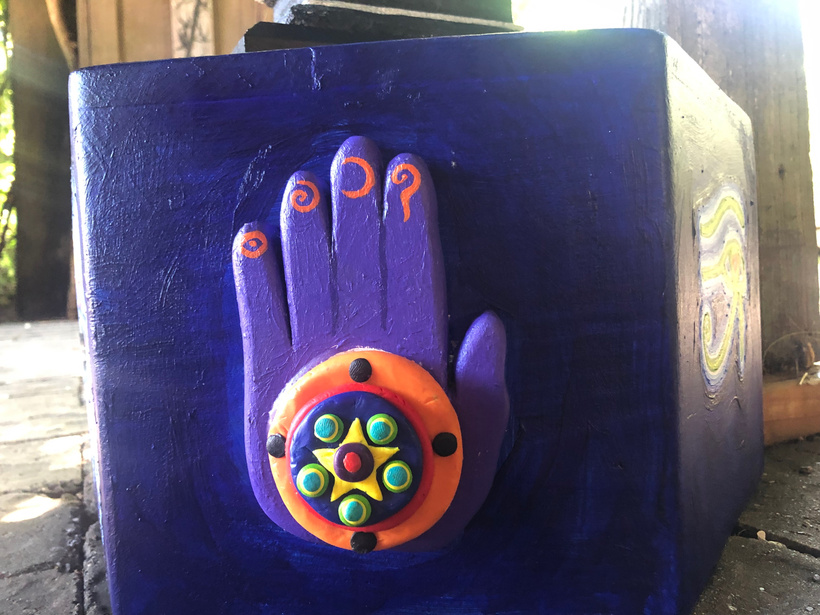
"Although the hamsa hand has been symbolic in Islam and Judaism for centuries, archeological digs in the Middle East provide evidence that the hamsa pre-dates these religions and originated with the Phoenicians and was used as a protective symbol for an ancient Middle Eastern goddess. The hamsa hand has always been associated with a female entity offering protection from evil and misfortune."
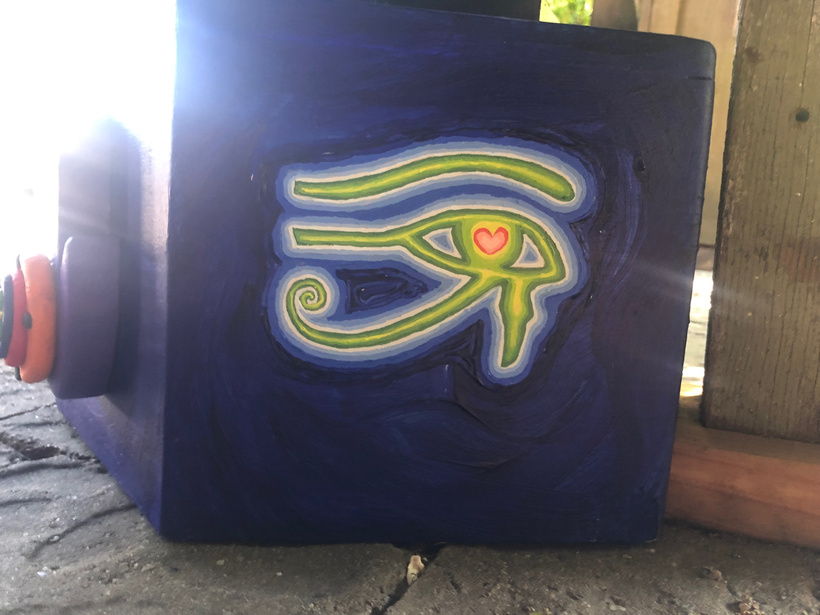
The origin of the Eye of Horus may be found in the myth of Set and Osiris. The ancient Egyptians believed that Osiris was the king of Egypt and that his brother, Set, desired his throne. Through trickery, Set succeeded in murdering his brother and became the new king. Osiris’ wife Isis, however, managed to bring her husband back to life temporarily through magic and became pregnant with Horus. Osiris went on to become the god of the Underworld and Isis raised Horus on her own. When Horus reached adulthood, he sought to avenge the death of his father. Horus fought Set in a series of battles, and eventually vanquished his uncle. During these struggles, however, he lost one of his eyes. According to one version of the myth, Set had ripped out Horus’ eye, tore it up into six parts and threw it away. In another version, it was Horus himself who gouged his eye out, as a sacrifice to bring his father back from the dead. In any case, Horus’ lost eye was magically restored by either by Hathor (often regarded to be the consort of Horus), or by Thoth, the god of wisdom.
(And Thoth was said to be the inventor of writing -- referred to by Socrates in his dismissal of the new communication technology):
SOCRATES: … Among the ancient gods of Naucratis in Egypt there was one to whom the bird called the ibis is sacred. The name of that divinity was Theuth, and it was he who first discovered number and calculation, geometry and astronomy, as well as the games of checkers and dice, and, above all else, writing.
Now the king of all Egypt at that time was Thamus, who lived in the great city in the upper region that the Greeks call Egyptian Thebes … . Theuth came to exhibit his arts to him and urged him to disseminate them to all the Egyptians. Thamus asked him about the usefulness of each art, and while Theuth was explaining it, Thamus praised him for whatever he thought was right in his explanations and criticized him for whatever he thought was wrong.
The story goes that Thamus said much to Theuth, both for and against each art, which it would take too long to repeat. But when they came to writing, Theuth said: “O King, here is something that, once learned, will make the Egyptians wiser and will improve their memory; I have discovered a potion for memory and for wisdom.” Thamus, however, replied: “O most expert Theuth, one man can give birth to the elements of an art, but only another can judge how they can benefit or harm those who will use them. And now, since you are the father of writing, your affection for it has made you describe its effects as the opposite of what they really are. In fact, it will introduce forgetfulness into the soul of those who learn it: they will not practice using their memory because they will put their trust in writing, which is external and depends on signs that belong to others, instead of trying to remember from the inside, completely on their own. You have not discovered a potion for remembering, but for reminding; you provide your students with the appearance of wisdom, not with its reality. Your invention will enable them to hear many things without being properly taught, and they will imagine that they have come to know much while for the most part they will know nothing. And they will be difficult to get along with, since they will merely appear to be wise instead of really being so.”