Didactic Megablock
Originally published for paying Patreon members on 2022-02-01. Republished here after a 90-day patron-first period.
I started out painting blocks for my grandson to play with. Then I glued eight 3X3X3 inch blocks into a 6X6X6 inch megablock. Sanded and gessoed. When I started looking at designs, I found myself creating a deliberately didactic object, intended to convey fundamental truths about the universe nonverbally. My grandson is intense about looking at the world. When he is able to talk about it, I hope to learn why he is obsessively interested in looking at the mosaic of paintings I call "Metapattern Recognition." My intention with the reconfigurable little paintings was to illustrate how small patterns can tile into larger patterns -- a visual lesson in seeing and looking. For the megablock, which I plan to show him soon, but will keep in my studio until he is old enough to lift it, I chose visual patterns that convey lessons: the Islamic pattern known as "the breath of the compassionate," the pattern known as "the lute of Pythagoras," and Fibonacci spirals painted over a framework constructed on the the principle of the "golden section." A few words about each:
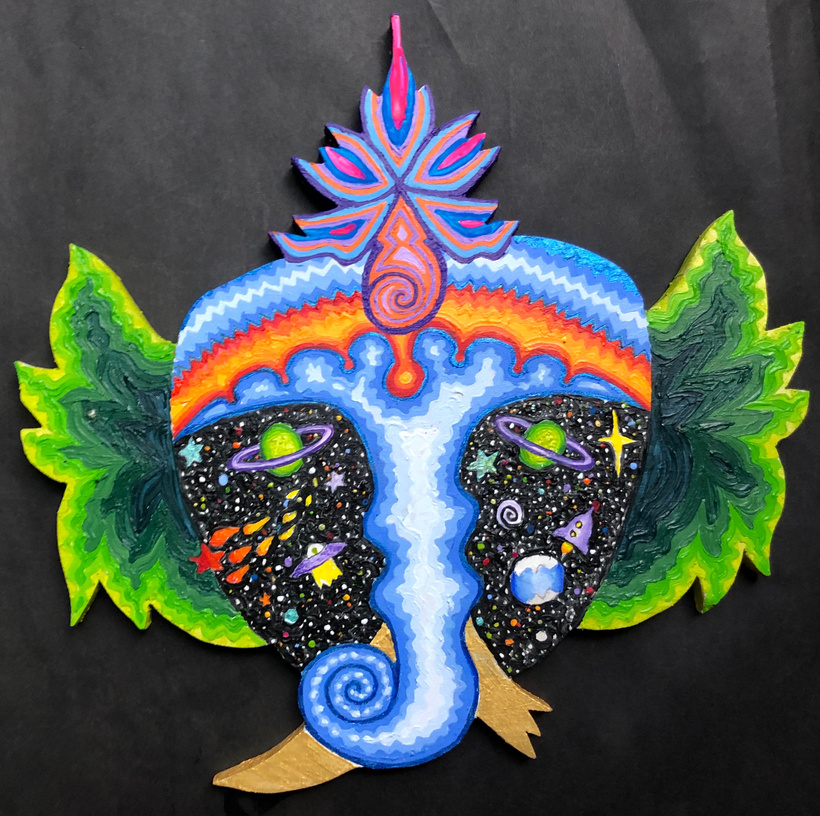
As is often the case, I don't discover images that resonate with me by starting with their meaning -- I am attracted to certain patterns and then learn enough about them to understand how they resonate with my personal archetypes. I was fascinated by Garuda and Ganesh before I learned their significance. I just liked the way they looked -- liked it in a certain way that I can feel but not describe verbally. When I looked him up, I understood why I resonated with Ganesh. He is the remover of obstacles, starting with existence itself: he sits in the portal between time and space and the first obstacle he removed allowed the universe to happen. Moreover, he is the patron of writers:
When Sage Vyasa began composing the Mahabharat, he asked Ganesh to be his scribe. Ganesha agreed on one condition: that Vyasa would recite without stopping. Vyasa posed a counter: that Ganesha would not write down the meaning of a verse that he did not understand. Ganesha agreed and work on the epic began. As the sage recited, the god wrote. Whenever he needed to rest, Vyasa would sneak in a complicated verse. The young god had to stop to figure it out and Vyasa would take a breather and compose more verses. And so it went on. One day, Ganesha’s pen broke while writing. Now, under the terms of their agreement, he couldn’t stop. So he just broke off his tusk and used it as a pen. Thus the epic was finished.
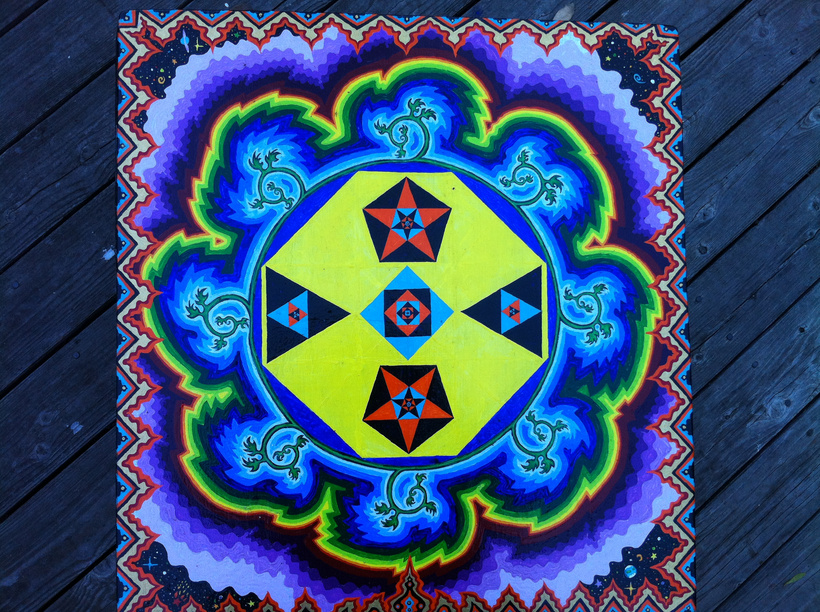
I'm a great enthusiast of the practical, scientific, eclectic, metaphysical "Beginner's Guide to Constructing The Universe," which embeds exercises in constructing fundamental polygons with compass and straightedge -- triangle, square, pentagram, etc -- in a broad cosmological, scientific, spiritual context. I once painted an outdoor table that included the construction of the triangle, square, and pentagram from the vesica piscis:
In terms of adhering to a belief in a particular description of the mystery I feel but can't truly describe, I'm agnostic. Much of my spirituality has evolved from my direct psychedelic experiences, starting nearly sixty years ago. And part of that experience was the growing awareness of the relationships among symbol, beauty, the mathematical manifestations of the material universe, and the growing world. Beginner's Guide describes this better than I can:
This fascinating characteristic of living forms curiously corresponds with the geometric property of the pentagram to replicate forever smaller and larger versions of itself. The star replicates and inverts itself in its own central pentagon, in and endlessly diminishing series of inverting stars... The Pentad holds the principles of regeneration. It is nature's way of producing endless variety using a single self-reproducing scheme.
...
The ancient Greeks discovered, or more likely learned from the Egyptians, that the human body is ideally structured in part and whole according to the golden mean (phi).... A core theme in ancient philosophy is that of the microcosm of the whole, the macrocosm...We contain smaller similar structures, and we are part of, and models of, larger structures of the cosmos.
...
The recognition of the phi relationship structuring material forms gives us a passkey to our inner selves. The body's structure is a mirror of our psyche, a denser expression of the energetic patterns of our soul. Body and soul somehow partake of the same design. But in what way can a mathematical ratio permeate our souls? Through beauty. A deep part of ourselves recognizes in flowers and dancers the beauty of the mathematical infinite and sees in it the endlessness of our own depths. Natural beauty resonates with the archetypal nature within us.
...
What makes spirals prevalent in cosmic design? They are the purest expression of moving energy. Wherever energy is left to move on its own it resolves into spirals. The universe moves and transforms as spirals, never straight lines... The spiral's role in nature is transformation. Similarly, in myth and religion it is the path of spiritual and mystical transformation.
These principles are portrayed on the side of the megablock devoted to four Fibonacci spirals, with the proportions of the golden section inscribed underneath. You can see the regeneration of the Pentad in the panel with a black background -- a figure known as "the lute of Pythagoras." It is constructed with pentagons with inscribed pentagrams and the sides of the pentagrams are the sides of the smaller pentagons. The form is a fractal, a dimension between dimensions that enables an infinite progression of forms fits into a finite space. The triangles are isosceles triangle with two equal sides and an apex angle of 36 degrees, which makes them "golden triangles".
The interlocking figures that enclose 8 and 10 pointed stars are representations of the pattern known in Islamic geometric art as "the breath of the compassionate." Again, I knew when I first saw photographs that the artisans who created the tiled ceilings of the Alhambra were plugged directly into what Ginsberg called "the starry dynamo in the machinery of night." I later learned that the tiling of the Alhambra exhibited all of the 17 kinds of possible crystalline symmetry. In the words of one contemporary crystallographer: (both links download PDFs)
Tiling Theory studies how one might cover the plane with various shapes. Medieval Islamic artisans developed intricate geometric tilings to decorate their mosques, mausoleums, and shrines. Some of these patterns, called girih tilings, first appeared in the 12th Century AD. Recent investigations show these medieval tilings contain symmetries similar to those found in aperiodic Penrose tilings first investigated in the West in the 1970’s. These intriguing discoveries may suggest that the mathematical understanding of these artisans was much deeper than originally thought.
Islamic tiling is its own universe of sacred geometry. The perception and the construction of these patterns are treated as tools of spiritual transformation:
Authors such as Keith Critchlow[a] argue that Islamic patterns are created to lead the viewer to an understanding of the underlying reality, rather than being mere decoration, as writers interested only in pattern sometimes imply.[6][7] In Islamic culture, the patterns are believed to be the bridge to the spiritual realm, the instrument to purify the mind and the soul.[8] David Wade[b] states that "Much of the art of Islam, whether in architecture, ceramics, textiles or books, is the art of decoration – which is to say, of transformation."[9]
Critchlow and others teach workshops through which practitioners approach their own psychospiritual transformation through the physical construction of designs such as the one known as "the breath of the compassionate."
Critchlow and his students, including Richard and Adam, work to articulate those structural insights by reconstructing the geometrical forms one step at a time. Implicit in this workshop is the sense of a spiritual discipline in following, re-enacting the construction of a pattern, as if those of us laboriously following the model before us could also abstract ourselves from three dimensions to two or even one, from embodiment to spirit. Certainly the room is full of concentration, and amusement at our struggles.
...a pattern of khatams touching at the points of the dynamic squares creates a pattern known as the breath of compassion (or breath of the compassionate), after the work of medieval Islamic philosopher Ibn Arabi, who spent time in Fez.
After class, I ask Richard to explain the pattern and the reason for its name more fully, then I go back to my hotel room with its functioning internet and look up Ibn Arabi. Here’s what I find:
“Ibn al-‘Arabî looks at God’s creativity as an analogue of human speech. Just as we create words and sentences in the substratum of breath, so God creates the universe by articulating words in the Breath of the All-Merciful (nafas al-rahmân), which is the deployment of existence (inbisât al-wujûd); indeed, existence itself is synonymous with mercy (rahma).” [“Ibn Arabi,” Stanford Encyclopedia of Philosophy, online, first published 2008]
In summary, the metapattern recognition sides present a visual exercise in compressing and expanding visual abstraction, the Fibonacci spirals and Lute of Pythagoras express the cosmic patterns underlying our sense of beauty, and the breath of the compassionate combines crystalline symmetries, tiling of foreground and background -- all visual-cognitive instruments that are both nonverbally didactic and fun to look at and create.