Co-creating Curriculum
After 10 years of teaching college students, I can think of one thing I wish I had done earlier: including learners in shaping the curriculum. Of course, I'm the expert on the subject matter, and (because the subject matter involves social media) how to use social media for learning. But we all quickly learned that these days nobody can be an expert in all social media. In our Stanford "Social Media Literacies" course, we started devoting 10 minutes of class time each week to a social media show-and-tell. Of course I and probably all my students knew about Tumblr at that time, but one of us know a great deal about a particular subculture of young, female, smart, snarky K-pop fans. Others knew sophisticated ways to navigate YouTube. By the time they were college seniors and grad students, certainly the learners in that course also knew something about how college courses are constructed.
So I did something during my last quarter that I wish I had done earlier: On the third of eight class meetings, I wrote down with a blue marker all the required learning activities on the whiteboard, including forum posts, blog posts, online comments, wiki collaboration, co-teaching teams. I also wrote my phone number on the whiteboard and told them to revise the curriculum in a way that works better for them -- and to text me when they had questions or had finished their exercise. I returned to find that they had annotated the learning activities with blue marker.
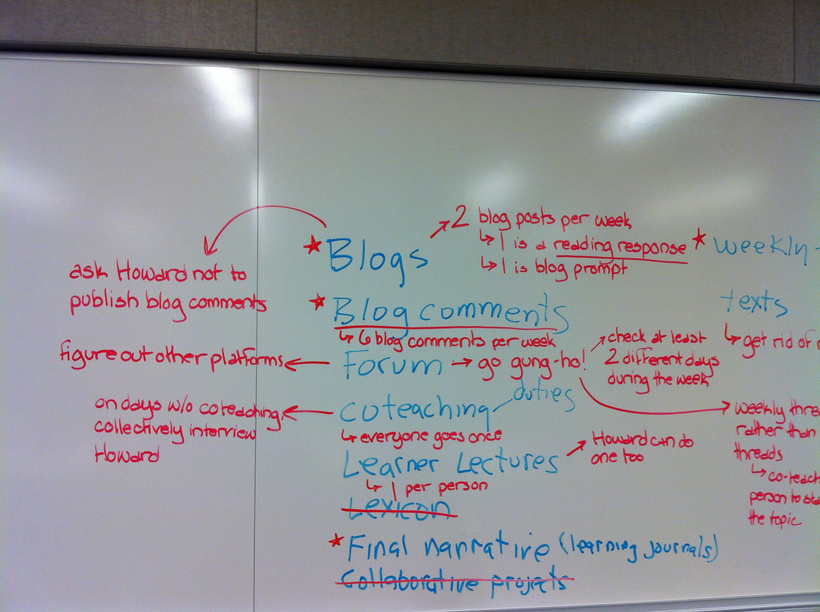
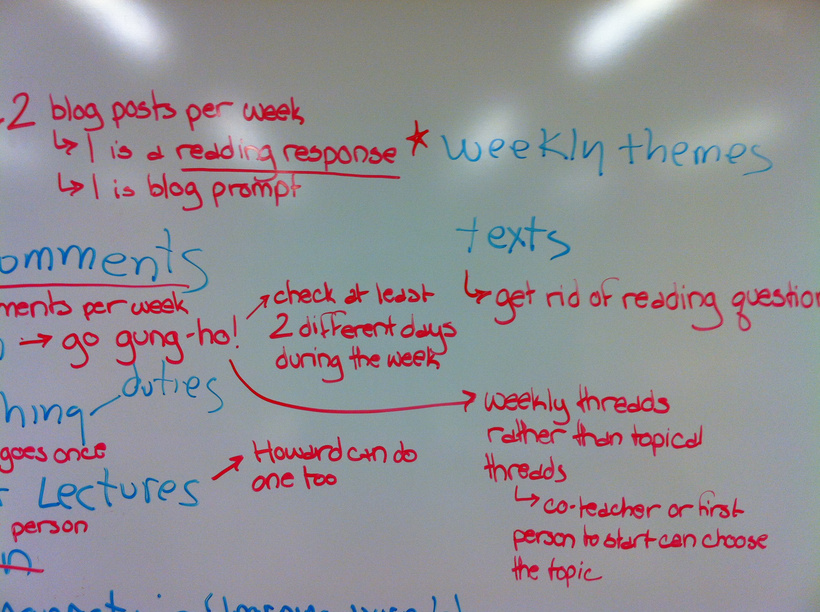
For example, they preferred Reddit, so we created a subreddit instead of using the forum platform started with. We talked about why this and other proposed changes worked better for them, and our conversation during the last class plus anonymous evaluations led me to conclude that the experiment was a success, if for no other reason than enabling learner agency.
During the last half of our final course meeting, we also returned to the commitment I had asked everyone to make before they were admitted to the course, in regard to how we would do things differently. In that conversation, consensus was that even earlier and more interventions that granted more agency -- and responsibility -- to the learner would be worth trying. I
n an ideal world, we fantasized, learners could take all summer before the Fall term to look over the syllabus, then we would convene online weeks before term started to co-redesign the syllabus -- an activity that I know Cathy Davidson has done successfully:
This course is designed using active learning methods that will engage students in projects meaningful to them, that they can help shape, and which include students in the development of the course itself. Much research on active learning shows these methods to be invaluable to empowering graduate students (even in the context of graduate studies which is often remarkably infantilizing and hierarchical). For those who are teaching, it offers pedagogical methods to be incorporated into your own classrooms.
The syllabus evolves until the course opens—and continues once the class begins as students are key in shaping the form, methods, content, and projects the class pursues and are co-designers of a unique learning experience that best serves their own careers, as researchers, thinkers, scholars, teachers, institution builders and beyond.