Foundations of Human Sociality
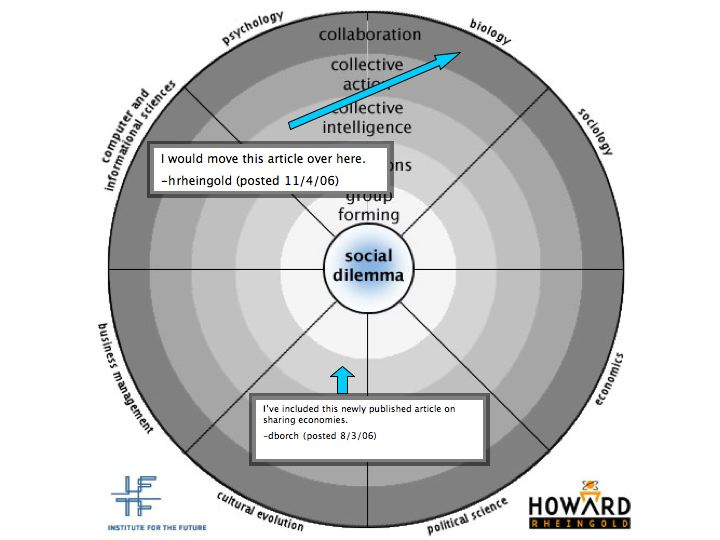
When I was working with Institute for the Future on what we called "the cooperation project," we recognized that insights regarding human cooperation were fragmented among different disciplines that were often unaware of converging work. So we created these summaries. My original vision, which was not implemented, was to arrange these resources on a visual clickable digital map: Hover over a node and a one sentence summary pops up; hold mouse down and a one paragraph summary pops up; click through to see the entire summary.
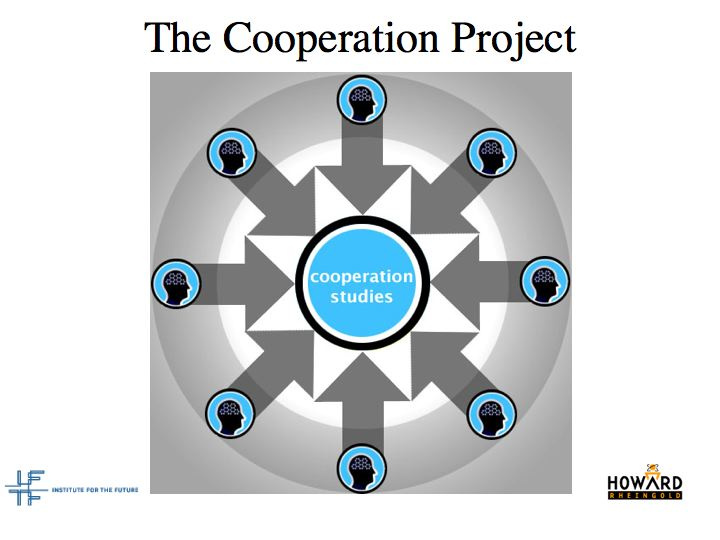
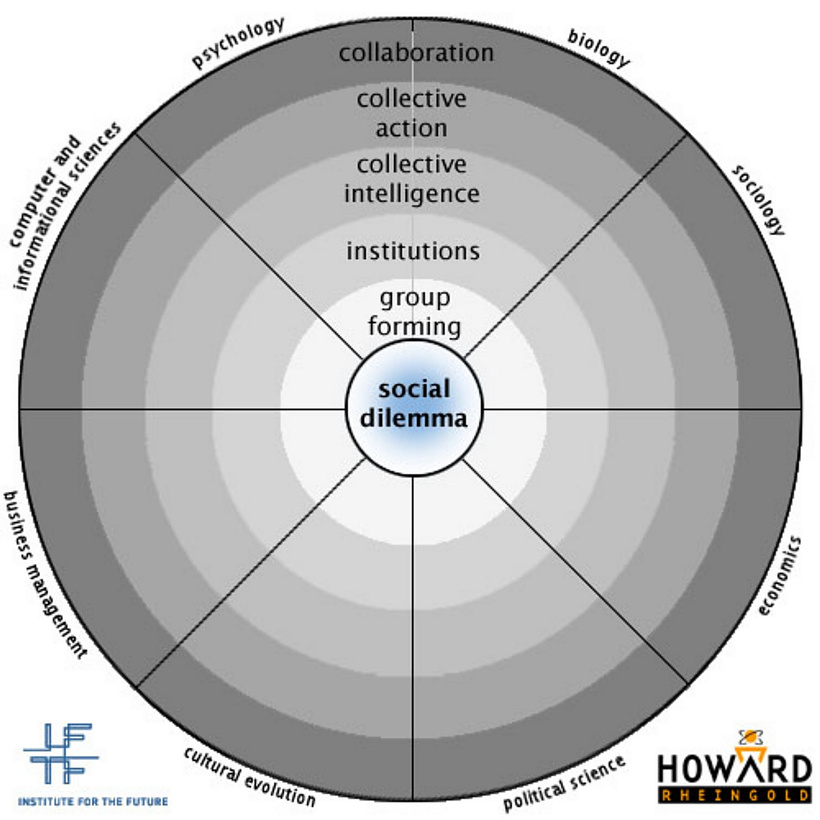
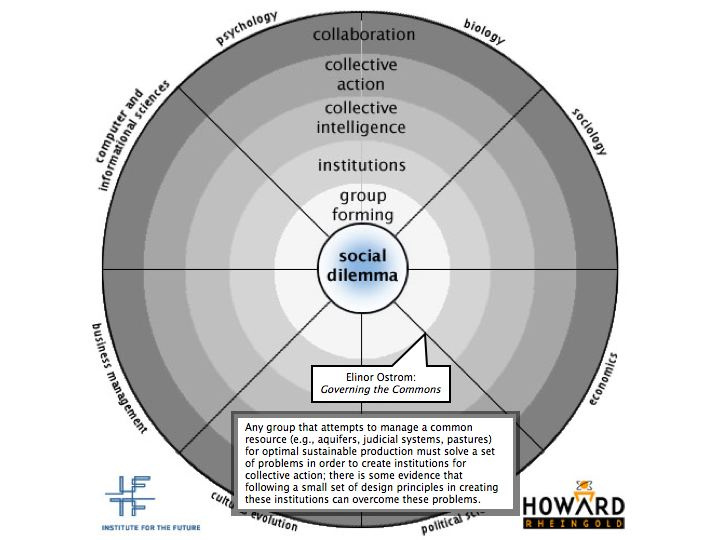
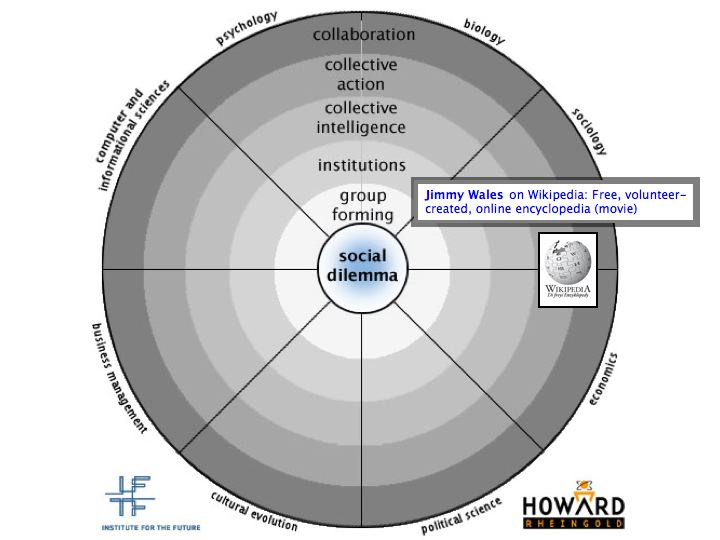
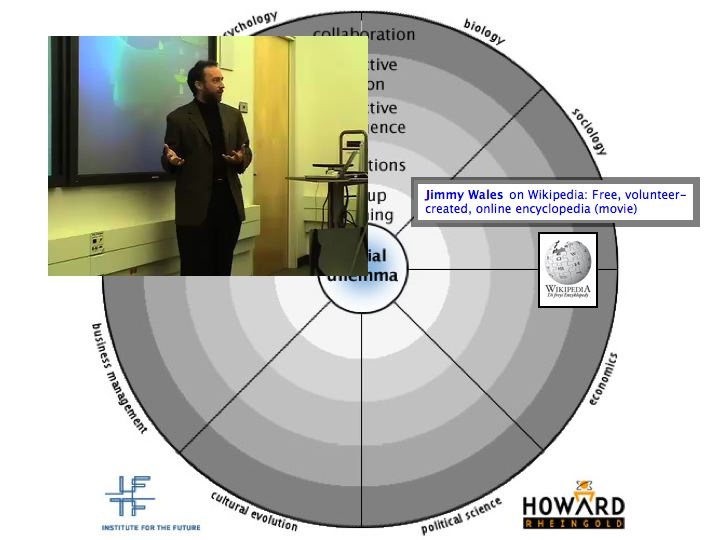
I saw the map as a collaboration tool, enabling annotation and embedded video.
Title: Foundations of Human Sociality (Introduction and Overview)
Oxford University Press, 2004
URL: https://academic.oup.com/book/8134
Authors: Robert Boyd, Samuel Bowles, Colin Camerer, Ernst F. Fehr, Herbert, Herbert Gintis, Joseph Henrich, Richard McElreath
Findings:
People are willing to reward fairness and reciprocity and punish those who do not act pro-socially, even at cost to themselves.
Group-level differences in behavior proved to be greater than individual-level differences, indicating cooperative behavior might be more embedded in cultural conditions than was previously thought. While one culture might take advantage of a person who is too altruistic, another might exclude a person for being too self-interested.
One Sentence:
Experiments like the Ultimatum Game and the Public Goods Game (one shot games for real money divided among strangers) that have been conducted in different countries all over the world have shown that group behavior frequently does not fit the traditional model of self-interested actors, that it is too richly varied between cultures to support a universal sense of fairness, and that a higher degree of market integration and higher payoffs to cooperation can be linked to greater levels of prosocial behavior.
One Paragraph:
The self-regarding and outcome oriented picture of human behavior presented in traditional economics does not explain why humans care so much about each other and about how social interaction is carried out, not just the end goals. The Ultimatum Game, designed by Werner Guth, is just one illustration of how real people will not always follow the dictates of self-interested rationality. Two subjects are given a sum of money, one is given the power to divide the sum, and the other can either accept or reject (in which case neither get any money). Research from conducting hundreds of trials of the game with thousands of students in Europe, Japan and the USA has shown that the responders frequently reject low offers and proposers frequently propose near equal divisions, even though it is to their monetary disadvantage. While early experiments on undergraduates seemed to suggest that there was a universal sense of fairness, extended research in different cultures (hunter-gatherers, slash-and-burn agriculturists, nomadic pastoralists) has exposed much cultural variation in responses, indicating that local cultural conditions play an important role in how people approach cooperation.
One Page:
The self-regarding and outcome oriented picture of human behavior presented in traditional economics does not explain why humans care so much about each other and about how social interaction is carried out, not just the end goals. The Ultimatum Game, designed by Werner Guth, is just one illustration of how real people will not always follow the dictates of self-interested rationality. Two subjects are given a sum of money, one is given the power to divide the sum, and the other can either accept or reject (in which case neither get any money). Research from conducting hundreds of trials of the game with thousands of students in Europe, Japan and the USA has shown that the responders frequently reject low offers and proposers frequently propose near equal divisions, even though it is to their monetary disadvantage. While early experiments on undergraduates seemed to suggest that there was a universal sense of fairness, extended research in different cultures (hunter-gatherers, slash-and-burn agriculturists, nomadic pastoralists) has exposed much cultural variation in responses, indicating that local cultural conditions play an important role in how people approach cooperation.
While mean proposals for university students from all over the world was usually between 42 and 48 percent, mean proposals from this cross-cultural study varied from 25 to 57 percent. Rejection rates, the action of the responders, also varied considerable between groups. Individual-level economic and demographic variables did not explain behavior as well as group-level behavior, and game play often could be connected to the people's common patterns of interaction. For example, the Orma recognized that one of the experiment's games was similar to the harambee, a local institution of giving to public goods like roads and schools. They began calling it 'the harambee game' and displayed highly prosocial behavior. In other groups, like the Au and Gnau, frequent rejection of generous offers can be explained by a cultural association with gift-giving: accumulating gifts, even if unsolicited, can imply a lowered status and force the receiver into future obligations or political alliance. The cross-cultural study showed that, in the case of groups at the extremes of behavior, "contrasting behaviors seem to reflect their differing patterns of everyday life, not any underlying logic of hunter-gatherer life ways."
The effect of market integration on cooperation to obtain a monetary reward can be explained easily: individuals from market-oriented societies when put in the context of one of the games are able to seek analogues in their daily activities of using and trading money with strangers. "Those who do not customarily deal with strangers in mutually advantageous ways may be more likely to treat anonymous interactions as hostile or threatening, or as occasions for the opportunistic pursuit of self-interest."