News Radars, Collective Curation, and Infotention
Originally published for paying Patreon members on 2024-01-10. Republished here after a 90-day patron-first period.
In the olden days, many of us online curated for each other the best online info we found on a cornucopia of topics; a big part of what was then known as "the blogosphere" adhered to the original format of the "web log" -- a link (or more) and an explanation of why the link is useful (or why the creator of the link is an idiot). Finding relevant information just in time was, for some of us, a collective activity. Much of that has died out in the age of social media, but the need for information and knowledge-creation skills is greater than ever.
A decade ago, I taught digital journalism and social media literacy courses to university students. Back before the tsunamis of misinfo-disinfo-vitriol inundated the online infosphere, knowing how to first of all cope with info overload and ultimately to tune your info inputs and outputs knowledgeably was a skill and worldview I thought worthy of teaching at that time.
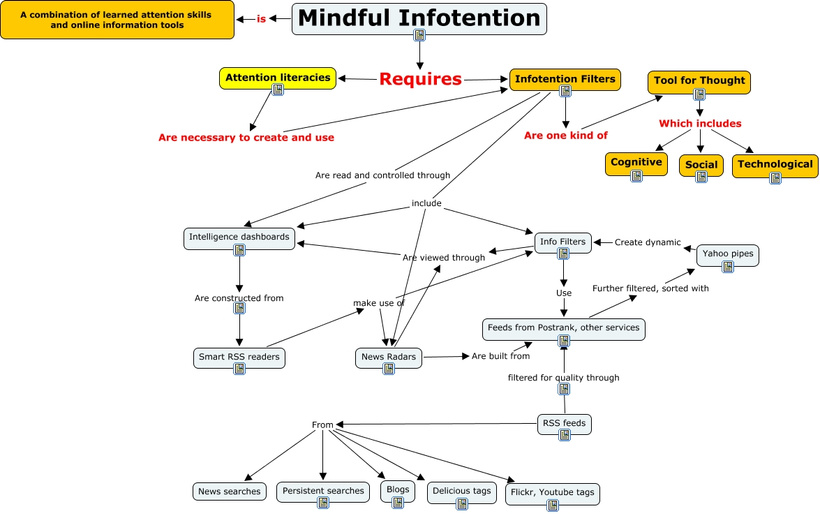
At the same time that I introduced learners to methods to find, filter, sift, and verify information, I taught metacognition and attention to one's own attention. Together, I called this combination of psychological and technical skills "Infotention." In addition to my in-person classes, I taught an online webinar on Infotention Skills: From Information Overload to Knowledge Navigation -- the syllabus breaks down the need and the elements.
The foundation of the technical side of infotention was and is RSS, the capability of websites to broadcast changes and of individuals to tune into those broadcasts. Dashboards like Netvibes made it possible to set up selective incoming information feeds on specific topics. Back then, a marvelous and sadly discontinued utility, Yahoo Pipes, made it possible for non-programmers to manipulate, find, and filter RSS streams. I even made a clickable concept map of the psycho-technical process.
All of which is to say that I think Robin Good's work on creating "News Radars" (image at top of post is a link) is worthy of your attention if the issues I just explicated interest you personally or professionally. I interviewed him about curation twelve years ago.