Psychic Fields & Co-learning in the Classroom
When I started teaching college students, I had confidence in my knowledge of the subject matter, and I was already making a living as a speaker, but I had no training as a classroom teacher. The first book I turned to was Neil Postman and Charles Weingartner's "Teaching as a Subversive Activity:"
Our educational system is traditional and backward-looking, and it produces students who cannot deal with change. It consists of an irrelevant, structured "subject matter" system where subject matter knowledge is the end goal, a paradox in an age of change. Traditional classroom organization must be eliminated (including grades, desks, courses, and administrations), and an inquiry system must be instituted which is devoted to instruction in the process of learning to develop in students competent "crap detectors" (with which they can deal effectively with change). A curriculum which trains students in the processes of learning, recognizing that the critical content of any learning experience is the method or process through which the learning occurs, must be student-centered, question-centered, and language-centered: it must consist of relevant questions (selected by the students as worth knowing the answers to) which will help students to develop and internalize concepts which are appropriate to reality; it must take place in a questioning, meaningmaking atmosphere in which students "learn by doing" how to be a successful learner and in which the teacher serves as a guide; and it must include a study of the new media language and of the relationships of language to reality so that the student can develop standards by which he can judge the value of perception.
I was attracted to Postman and Weingartner because it was clear that learning how to learn one's way through the changing worlds of social media was more important than the knowledge of how online discourse works now. Also, the sheer one-pointed concentration on grades among many students at "elite" universities suggested to me that for a real learning community to emerge, I would have to learn something about deprogramming learners from the grades mindset. (If it had been available then, I would have dived into the work of Jesse Stommel and others on "Ungrading." Which I highly recommend to all educators.) I was also interested in the idea of creating a temporary learning community in the 10-15 weeks during which we would meet face to face for 3 hours a week (Stanford operates on a quarter system, UC on a semester system -- I favor the longer term in order to foster the co-learning community idea in addition to teaching the subject matter of the course.)
I was also impressed by a source that some would consider crossing the border into woo-woo: Christopher Bache's "The Living Classroom: Teaching and Collective Consciousness" contends that every classroom filled with learners produces a kind of psychic field, a product of the micro-signals everyone is sending out.
Christopher M. Bache examines the subtle influences that radiate invisibly around teachers as they work--unintended, cognitive resonances that spring up between teachers and students in the classroom. While these kinds of synchronistic connections are often overlooked by traditional academics, Bache demonstrates that they occur too frequently and are too pointed to be dismissed as mere coincidence. Drawing upon Rupert Sheldrake's theory of morphic fields, Bache proposes that well-taught courses generate "learning fields" around them, forms of collective consciousness that can trigger new insights and startling personal transformations.
I am not advocating Sheldrake's even more radical notion of morphic fields. I did, however, encounter the classroom variety of psychic field early and often in my first year teaching. The grossest of those micro-signals that every face-to-face teacher recognizes are the facial expressions we see when more than one student doesn't know what I am referencing. It is the duty of and challenge for the teacher to manage and steer and catalyze that field. And I found that what I told the students they could believe we were doing together radically changed the field and we all recognized the change. When I told them that I was learning to teach while they were learning the subject matter, and that we were all co-learners, they started believing that -- because students project such authority on the teacher and because my partial suspension of my lofty status as educator and admission that I was also a student challenged them to respond. Is that psychic field supernatural? I'd say that rather it is supersensory. And diligent practice can attune one to it, and enable a teacher to manipulate it.
On the first day of class for a course, I required a classroom with movable chairs and tables. At Stanford, because my courses were about social media issues and literacies, I had the privilege of teaching in the Wallenberg Learning theater, with a large wall tiled with interconnected screens and three glass walls that we could write on.
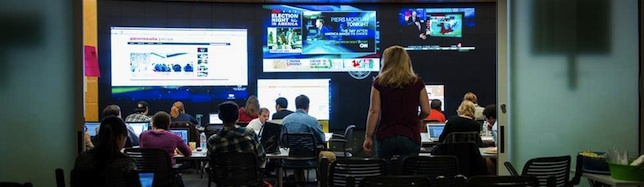
The sexy technology wasn't as important to setting the scene for a co-learning community -- although it certainly was useful later when exploring media. The traditional chairs and tables were the first important tool. As students entered the room on the first day of class, I greeted them, asked their name, and invited them to take a chair from the stack. Invariably, the cohort would set up their chairs in rows and columns. If I didn't intervene, they would sit in the same place the next time they set up the chairs. So after they all assembled I asked them to move the chairs in a circle and I sat among them. No back row. No lectern. I didn't invent the trope, but I told the students that if a warrior from a thousand years ago was transported to a contemporary battlefield, they would die quickly. A surgeon from a thousand years ago would be stopped by the hand-washing ritual before stepping into a room with strange equipment and lighting. But students and a teacher from a thousand years ago would know exactly who sat, who stood, who faced who, who was in charge.

https://art-of-reasoning.huygens.knaw.nl/classroom
I didn't invent learning in a circle, of course. Looking into it brought me to Harrison Owens' Open Space Technology, a way of creating self-organized group discussions that involves both conversation circles and co-organizing. If you attend an "unconference" where the participants self-organize workshops, you are experiencing a version of Open Space.
At first it was scary, opening up to my students that I was in the process of learning how to teach, but in addition to re-arranging the furniture and inviting them to believe in their participation in a learning community, I demonstrated and modeled what I was asking them to do. And I made clear what I was asking them to do when I required them to read and respond to my statement about how we would learn together before they were admitted to the course. Admittedly, I was supported by the privilege of teaching a small seminar and requiring a brief entrance application.
Another factor that influenced whether or not a learning community would gel -- and it sometimes failed to gel -- was whether we could arrange a lunch or preferably a dinner together early in the term. Encountering each other in three settings: the classroom, online, and dinner, tended to lead to success. We need to know and care about each other, at least a little, if we are to learn cooperatively as well as collaboratively. I picked that up decades ago when I encountered my first online learning community.